
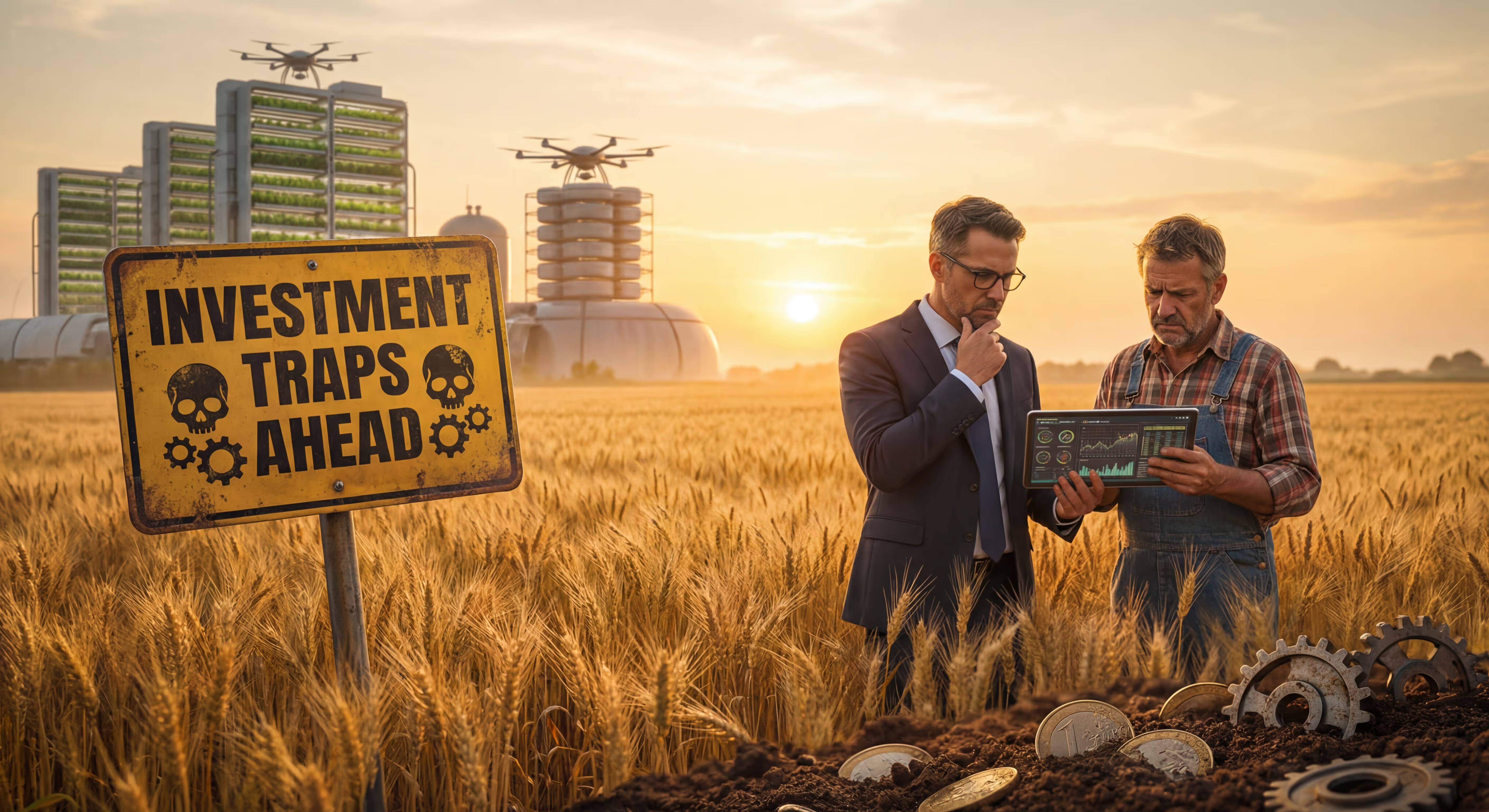
Three Traps of Agricultural Investment: Lessons from Zhejiang Agricultural Expo
Anyone who has been to the Zhejiang Agricultural Expo will be amazed by the “high-tech agriculture” in the exhibition hall: drone crop protection, AI pig farming, blockchain traceability… But when you actually step into the fields, you’ll discover a harsh truth—agriculture is not a slow business, but a high-risk one.
Here are the three most common traps I’ve observed.
Trap One: Scale Illusion
Misconception: Thinking agriculture works like the internet, where larger scale means lower marginal costs.
Reality: Agriculture’s marginal cost curve is U-shaped.
At the Zhejiang Agricultural Expo, a “smart agriculture” project showcased their 5,000-acre digital tea plantation. It sounds beautiful: one system manages 5,000 acres, with per-acre costs only 60% of traditional agriculture. But an old tea farmer with 20 years of experience asked me on the spot: “During those few days before Qingming Festival, when 5,000 acres of tea sprout simultaneously, where are you going to find enough tea pickers?”
In agriculture, scale is not a moat—it’s a liability.
The bottleneck in agriculture is always “people” and “time.” You can’t run three shifts like a factory, nor can you dispatch labor on-demand like food delivery. Tea leaves won’t wait for you, cherries won’t wait for you. The larger the scale, the more your coordination difficulty increases exponentially within critical time windows.
Lesson: The first question in agricultural investment shouldn’t be “how big can we get,” but “during the most critical 7 days, can we complete 80% of the work?”
Trap Two: Technology Worship
Misconception: Thinking technology can solve everything, especially “disruptive technology.”
Reality: Agriculture is a craft; technology can only assist, not replace.
The hottest booths at the agricultural expo are always “AI pig farming” and “IoT planting.” One entrepreneur spent half an hour telling me about his “pig face recognition” system—using cameras to identify each pig’s health status and automatically adjust feed ratios.
I asked him: “What happens after the system identifies a sick pig?”
He said: “The system will send an alert.”
“Then what?”
“Then the workers go handle it.”
“How do the workers know what to do?”
”…”
Technology’s breakpoint is always in the last mile. Agriculture is not standardized industry; every pig, every plant is a unique biological individual. When the system tells you “this pig might have a fever,” what’s truly valuable is the veterinarian who can tell at a glance “whether it’s flu or stress response,” not the system that detected the anomaly.
Many successful agricultural enterprises in Zhejiang actually have core competencies of “experienced master + appropriate technology.” Technology is an amplifier, but the prerequisite is having someone who knows which button to press.
Lesson: Beware of agricultural projects that claim to “eliminate human labor.” Agriculture’s moat is always human experience; technology is the tower on the moat, not the moat itself.
Trap Three: Channel Mismatch
Misconception: Thinking good products can command good prices, especially “direct supply to high-end markets.”
Reality: Pricing power in agriculture lies not in production, but in channels.
The most poignant scene at the agricultural expo: one exhibitor showcased their “organic strawberries,” with planting costs of 30 yuan/jin, priced at 80 yuan/jin, targeting “first-tier city high-end supermarkets.” I asked where they’re selling now, and he said: “Still negotiating channels.”
This is a typical channel mismatch.
Agriculture has a brutal rule: the farther from the land, the weaker the pricing power. No matter how good your strawberries are, one sentence from the high-end supermarket purchasing manager—“we need three months payment terms”—and your cash flow is broken. Not to mention cold chain logistics losses, shelf life management, promotional cost sharing…
Those truly profitable agricultural projects in Zhejiang often do things that look very “low-end”:
- Supplying school cafeterias (high volume, stable, short payment terms)
- Community group buying leaders (high repurchase, low loss)
- Pre-made ingredient supply (B2B, high standardization)
They don’t compete for “high-end,” they compete for “cash flow.”
Lesson: Agricultural investment isn’t just about “how well you can grow,” but more importantly “who you sell to, how you sell, and how soon you get paid.” Channel capability determines survival; product quality is just the entry ticket.
Summary
The essence of agricultural investment is managing extremely rigid human and time constraints within a highly uncertain biological system.
The Zhejiang Agricultural Expo showed me that the agricultural enterprises that survive aren’t necessarily the most technologically advanced, but those who best understand “proportion”—knowing where the ceiling of scale is, where technology should stop, and how to choose channels.
Agricultural investment isn’t about investing in the dream of “changing agriculture,” but in the patience to “respect agriculture.”
Published at: Feb 13, 2026 · Modified at: Feb 13, 2026